
Agentic AI
Decisions You Can Explain, Test, and Trust
Your optimization engine keeps making the decisions. An agent explains them, tests what-ifs, and diagnoses plans that cannot exist. Every number is checked first.
Example. Question: Why is order 422119/340 rolling on 11 Jul? Steps: Read the order record, Caster 2 slack by day, Lead times from parameters, 9 numbers checked. Answer: 50 T needed fresh steel. Caster 2 was full on days 1 to 4 and 6, so it was cast on 7 Jul, and 4 days to the yard makes 11 Jul the earliest roll.
You Invested in Optimization. Your Planners Still Work Around It.
The model has the answers. The people who run the operation cannot get to them.
Plans nobody can question
The engine returns a schedule, never a reason.
So they override what they cannot explain.
Every what-if waits in a queue
One person knows the model. The answer comes after the decision.
So they decide before the answer arrives.
Overrides nobody records
The fix goes into a spreadsheet. The reason goes nowhere.
So the model never learns from the fix.
A failed run stops the day
Nobody knows which rule broke, or what to change.
So they fall back to last week’s plan.
Agents close this gap: every answer grounded in the model, every what-if a real re-solve, and no reason to leave the tool.
Planners
Ask why the plan chose what it did, and test a change before committing to it.
Operations leaders
See what a disruption costs and what is at risk, with a re-plan in minutes.
Executives
Trade-offs on the table before the decision, not reconstructed after it.
The Engine Decides. The Agent Explains, Tests, and Recommends.
The language model never computes a plan.
Optimize
The engine solves the model: the best objective it can reach with every constraint satisfied.
Extract the evidence
The application reads the solution: KPIs, allocations, binding constraints and their slack.
Explain or act
The agent answers from that evidence, or acts through an approved tool: change an input, re-solve, compare.
Verify before display
Every quantity, date, and entity is matched to the solution. A mismatch is withheld, not explained away.
The agent
Explains plans and edits inputs. Never computes a plan.
The engine
Computes every plan and every re-solve.
The diagnosis
Names the colliding rules. Applies nothing.
Why the split: Ask a language model for a plan and it will produce one: fluent, confident, and infeasible. A solver proves a plan feasible. So the solver owns the plan, and the language model owns the conversation.
Capabilities on Top of Your Optimization Engine
Six capabilities. Three read the solved plan, three re-run the engine. None invents a number.
Read from the solved plan and live data
Explainability
Why the engine chose what it chose, with evidence.
“Why is this customer served from a farther DC?”
See it liveRoot-Cause Analysis
Which factors drive a result.
“Which cost elements make this customer unprofitable?”
Data Retrieval
Outputs and KPIs, by asking.
“Summarize the bottom five carriers by cost per ton per km.”
Re-run the engine, then compare
What-If Simulation
Describe a change. Re-solve. Compare.
“What is the cost impact of closing this DC?”
See it liveRecommendation
The move the engine supports, with its trade-off.
“Which customers should move to DC B for a net saving?”
Infeasibility Diagnosis
Why no plan exists, and what to change.
“Why is there no feasible plan after the caster outage?”
See it liveThe same capabilities apply whether the model plans steel, trucks, warehouses, or a distribution network.
Steel production planning
See It Working in SteelOpt AI
One connected plan from raw materials to finished orders, solved monthly and daily with Gurobi. Planners talk to Opti, the agent on top of it.
Order explainability
Why this order, this day
Scenario Planners
Ask, re-solve, compare
Ask Opti
KPIs and evidence, read-only
Infeasibility Doctor
Which rules collide
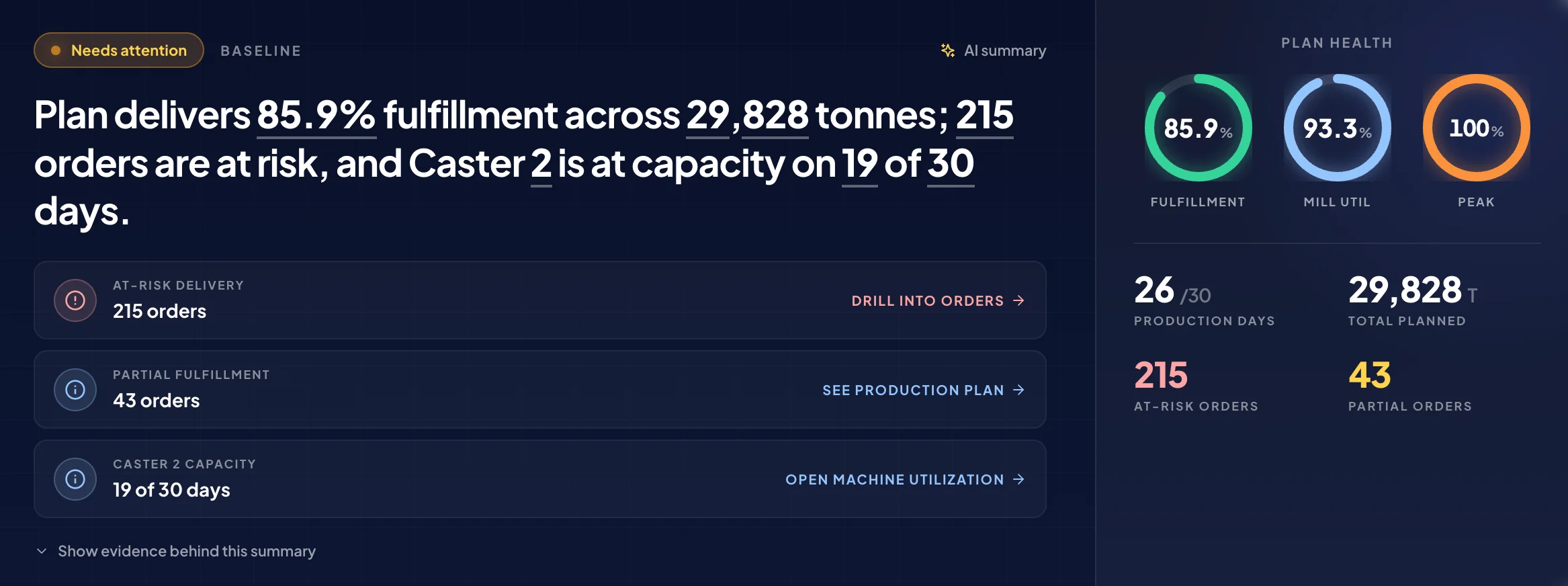
Try the three agent capabilities, on demo data
Explainability
Ask why. Get the solver’s evidence, not a guess.
Opti · AI Explainability
Why this order, this day?
Opening stock of BLT-0252-AKS73: 1,420 T, shared by 103 orders. 9 T allocated here.
② ④ Route of the 50 T and lead times
Controls a Governance Team Can Audit
Three gates sit between a question and an answer. Each can be checked against a run.
A question, in plain language
“Why is order 422119/340 rolling on 11 Jul?”
- G1
Gate 1 · Scope
Before anything moves
The agent cannot act beyond its tools.
- Approved tools only. No edits to the model, objective, or data.
- You approve every staged edit before a solve.
- Ambiguous request? The agent asks first.
- Any answer can be set aside.
The engine solves
Gurobi computes the plan. The agent never does.
- G2
Gate 2 · Verification
Before anything is shown
No invented number reaches a planner.
- Every quantity, date, and entity is checked against the evidence.
- Two failed drafts: a plain factual summary, no language model.
- Each explanation shows its check result.
- G3
Gate 3 · Provenance
Behind every answer
No forecast is mistaken for a solved plan.
- Comparisons come from two solved runs, never a forecast.
- The infeasibility diagnosis uses no language model.
- Limits are stated: a full constraint is not proof of cause, and clock times are estimates.
The answer on screen, with its sources
Agentic AI Across a Global FMCG Supply Chain
Built on a platform that already runs network, cost-to-serve, carrier, and vehicle decisions on optimization models.
Cost to serve
“Why does a higher-volume customer rank below a smaller one on profitability?”
Explainability · reads the plan
Customer sourcing
“Which customers are served by a DC other than the nearest one, and why?”
Root cause · reads the plan
Carrier performance
“Which carriers fell to the bottom ten this quarter, and on which lanes?”
Data retrieval · reads the plan
Network design
“What if we shift 15% of volume from this DC to the next one?”
What-if · re-runs the engine
SKU rationalization
“Which SKUs should we delist with the least turnover risk?”
Recommendation · re-runs the engine
Fleet mix
“What happens on this route if a new truck type is allowed?”
What-if · re-runs the engine
Agents that only read the plan go live first and earn trust. Only then do the agents that re-run the engine follow.
Start Small. Expand on Proof.
Agents need a model your planners already trust. If you have one, we build on it. If not, we build it first.
Map the questions
Sit with planners and leaders. List what they ask of a plan today, and what they stopped asking.
You getA use-case map
Ground the model
Wrap the engine with evidence and approved tools, so an agent can read, re-run, and compare.
You getAn agent-ready model
Prove it with real planners
Two or three agents on live runs, with every gate on from day one.
You getPlanner-proven agents
Expand on that evidence
Read-only agents first, then the ones that re-run the engine, in the order trust is earned.
You getThe full agent layer
What we bring
Operations Research scientists for the model, AI engineers for the agent layer, and safeguards already proven in production.
What we need from you
Access to the model, its data, and its documentation. Two or three planners to work with early releases. One leader who owns the decision the agents will support.
What you own
Your environment, your codebase, and the capability to extend it. Nothing runs outside your control.
Turn Your Optimization Model into a Decision Partner
Ask why, test a change, trust the answer. The same model, now answerable.